

How to Choose the Right EV Charger for Home, Workplace, or Fleet in 2026 (Complete Guide)
Jul 09,2026
You want fast and reliable EV charging for your home, office, or fleet. But the wrong charger choice creates slow sessions, high bills, and future headaches that cost time and money.
The right EV charger matches your daily needs, power capacity, and growth plans. Most homes and workplaces do best with a Level 2 unit that adds 25 to 60 miles of range per hour, while fleets need scalable and durable options with smart controls.
I have worked with many charge point operators, fleet managers, and property developers over the years at Parwatt. They all faced the same core question. This guide gives you a clear path to pick the charger that fits today and tomorrow.
Why Choosing the Wrong EV Charger Leads to Frustration and Wasted Money
You picked a charger that looked good on paper. Now your team waits too long, the electric bill jumps, or you cannot add more units later without big extra work.
Choosing the wrong EV charger often means slow charging speeds, surprise installation costs, high electricity bills, and limits on future expansion. These problems waste money and create daily stress for users and operators.
I once helped a small fleet operator who bought basic chargers without smart load management. His drivers lost hours every week because units tripped during peak hours. The company paid extra for overtime and lost delivery time. After we switched them to proper units, downtime dropped sharply. Let me break down why bad choices hurt so much in real situations.
For Home Users
Homeowners often buy the cheapest or highest power unit they see online. They ignore their panel capacity. A 100-amp home panel cannot safely run a 50-amp charger without upgrades. The project then costs double what they planned. Slow charging also means they still stop at public stations on long days. This defeats the main reason for home charging.
For Workplace and Real Estate Sites
Property managers want chargers that tenants love. But a unit without app control or scheduling creates conflicts. Multiple cars compete for the same spots. Tenants complain. The building pays higher demand charges from the utility. One retail chain I advised had to rip out early units after two years because they lacked reporting tools. The replacement project cost far more than doing it right the first time.
For Fleet Operators
Fleets live on uptime. A charger that cannot handle high daily cycles or lacks remote monitoring leads to stranded vehicles. Maintenance costs rise. Drivers get frustrated. One logistics company lost two days of routes because a single charger failed during a heat wave. They had no backup plan or smart alerts.
Here is a table that shows common pain from wrong choices:
| Use Case | Common Wrong Choice | Resulting Problem | Extra Cost or Loss |
|---|---|---|---|
| Home | Oversized charger | Panel upgrade + high bill | $1,500–$4,000 extra |
| Workplace | Basic charger no app | Tenant conflicts + demand fees | Lost rent + higher kWh |
| Fleet | Low durability unit | Frequent downtime + repairs | Missed deliveries + labor |
Bullet points of typical frustrations:
- Drivers or family members wait longer than expected.
- Electricity bills rise 30% or more in the first months.
- Adding a second charger later requires full rewiring.
- Safety issues appear when units overheat or trip breakers.
- Warranty claims get denied because the unit did not match the site.
Smart features like load balancing and scheduling solve many of these issues before they start. Our EC01 Wall Charger includes these controls and works well in mixed home and small fleet settings. Early planning avoids the regret cycle I see too often.
Common Mistakes When Selecting an EV Charger for Home, Work, or Fleet
People focus on one number like power output and ignore everything else. They later discover the charger does not fit their actual routine or site conditions.
Common mistakes include picking power level without checking the electrical panel, skipping smart features, ignoring installation limits, and forgetting about long-term expansion or maintenance needs. These errors lead to poor performance and higher total costs.
I talk with customers every week who made these exact mistakes. One workplace client chose a high-power unit because it looked fast on the spec sheet. Their panel could not support it. They spent months getting permits and extra wiring. Another fleet buyer ignored weatherproof ratings. The units failed after one winter season. Let me walk through the most frequent traps and how to avoid them.
Mistake 1: Only Looking at Power Output
Higher kW or amps does not always mean better. A 22kW unit in a home with a weak panel creates more problems than it solves. Most daily driving needs only Level 2 speeds. Faster charging helps on road trips but adds cost and complexity at fixed sites.
Mistake 2: Ignoring Site Electrical Conditions
You must know your available amps and whether the panel needs upgrading. Many older buildings and homes need $2,000 or more in electrical work. Skipping this check turns a $600 charger purchase into a $3,000 project.
Mistake 3: Choosing Units Without Smart Controls
Basic chargers work for single users. Shared sites need app control, usage reports, and load management. Without these, you cannot control who charges when or how much energy costs. Fleets especially need data to plan routes and shifts.
Mistake 4: Forgetting Future Growth
A charger that works today may block expansion tomorrow. Choose units that support software updates and higher power later. Vehicle-to-grid readiness also matters as more grids reward bidirectional charging.
Here is a comparison table of mistakes versus better approaches:
| Mistake | Typical Result | Better Approach | Benefit |
|---|---|---|---|
| Focus only on power | Panel overload or high cost | Match to daily range needed | Lower install cost and bills |
| Skip electrical assessment | Project delays and change orders | Get panel audit before buying | Accurate budget and timeline |
| No smart features | Usage conflicts and waste | Add app and load management | Better control and savings |
| No future-proofing | Early replacement needed | Select updatable and scalable units | Longer useful life |
Bullet points of quick checks before you buy:
- Measure your current panel capacity and spare amps.
- List how many vehicles will charge at the same time.
- Decide if indoor or outdoor rating is required.
- Check if your utility offers rebates for smart chargers.
- Ask about software update policy and OCPP support.
Our EP02 Portable EV Charger with Display gives flexibility for mixed home and small fleet use while including clear monitoring. Reading our Level 2 vs Level 3 Charging post helps many customers avoid the power-level trap.
These mistakes are easy to prevent with a short checklist and honest site review.
How to Choose the Right EV Charger: Key Factors for Home, Workplace, and Fleet
You need a simple way to compare options across different settings. Focus on the factors that actually affect daily operation and total cost.
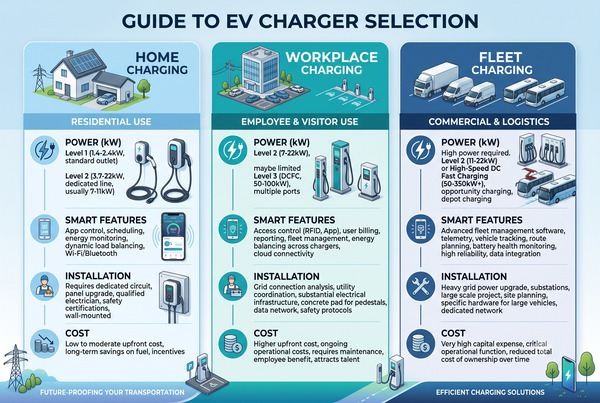
Key factors include charging speed and power level, smart features for control and savings, installation requirements, upfront and running costs, and the ability to expand later. Weigh these against your specific use case for the best long-term value.
I break this down for the three main audiences I serve at Parwatt. Home users want simple convenience. Workplaces need fair sharing and low management effort. Fleets demand high uptime and data. Each factor plays out differently.
Charging Speed and Power Level
Level 2 chargers remain the sweet spot for most fixed locations in 2026. They add 25 to 60 miles of range per hour. This covers typical daily driving without the high cost and grid impact of DC fast chargers. Home and workplace sites rarely need more than 7 to 11 kW per unit. Fleets with high daily mileage may use a mix of Level 2 overnight and selective DC for quick top-ups.
Smart Features and Controls
App control, scheduling, load balancing, and usage reports have become essential. Load management prevents breaker trips and lowers demand charges. Scheduling lets you charge when electricity rates are lowest. Reports help fleets track energy per vehicle and spot problems early. These features pay for themselves quickly in shared or commercial settings.
Installation Requirements
Check your electrical panel, wiring distance, and whether the site is indoor or outdoor. Permitting and inspection add time and cost. Outdoor units need proper weather ratings. Some locations require concrete pads or trenching. Early assessment avoids surprises.
Cost and Incentives
Look beyond the charger price. Include installation, possible panel upgrades, electricity rates, and maintenance. Many areas still offer rebates or tax credits in 2026. Smart chargers often qualify for higher incentives because they support grid stability.
Future-Proofing and Scalability
Choose units that accept software updates and can grow with your needs. OCPP compatibility matters for fleets and multi-site operators. Some models now support vehicle-to-grid functions that may create revenue later.
Here is a decision table by use case:
| Factor | Home Priority | Workplace Priority | Fleet Priority |
|---|---|---|---|
| Power Level | 7–11 kW Level 2 | 7–22 kW with sharing | Mix Level 2 + selective DC |
| Smart Features | Basic app and scheduling | Full management and reports | Remote monitoring + alerts |
| Installation | Simple wall mount | Multiple units + networking | Durable and scalable |
| Total Cost Focus | Low install + incentives | Low management + tenant use | High uptime + low downtime |
| Expansion | Add one more unit later | Add many units over time | High daily utilization |
Bullet points of practical questions to ask:
- How many miles does each vehicle drive per day?
- How many vehicles charge at the same time?
- What are the peak and off-peak electricity rates?
- Will the site grow in the next three years?
- Does the charger support remote diagnostics?
Our Electric Vehicle Charging guide and AC vs DC EV Charging posts give deeper comparisons on power choices. Matching the charger to real daily use prevents both under-performance and over-spending.
Best EV Charger Recommendations by Use Case in 2026
You want concrete suggestions that fit each setting without guesswork.
Home users do well with reliable wall-mounted Level 2 units that include app control. Workplaces benefit from networked smart chargers that manage multiple users. Fleets need durable, high-utilization units with strong monitoring and easy scaling.
I recommend based on thousands of real installations and feedback from Parwatt customers across North America and Europe. These choices balance performance, cost, and future needs.
Home Use
Pick a 7 to 11 kW Level 2 wall charger with scheduling and basic load management. This gives enough range for daily commuting while keeping install costs low. Our EC01 Wall Charger fits most garages and includes clear app control. It works on standard 240V circuits and supports time-of-use rates to lower bills.
Workplace and Retail Sites
Choose networked Level 2 chargers with user authentication, usage reporting, and dynamic load balancing. These features prevent conflicts and help control energy costs. Multiple units can share available power so the building stays within limits. Look for OCPP support if you may add more sites later.
Fleet and Logistics Operations
Fleets need chargers built for high daily cycles and outdoor conditions. Combine overnight Level 2 charging with selective higher-power units for quick turns. Remote monitoring and alerts reduce downtime. Scalable designs let you add units as the fleet grows. Our mobile and fixed high-power options support this mixed approach.
Here is a recommendation summary table:
| Use Case | Recommended Type | Key Features to Prioritize | Example Parwatt Fit |
|---|---|---|---|
| Home | Wall-mounted Level 2 | App, scheduling, simple install | EC01 Wall Charger |
| Workplace | Networked Level 2 | User control, reports, load share | Smart models with OCPP |
| Fleet | Mix Level 2 + mobile/high-use | Durability, remote alerts, scale | FES-D30 or power module series |
Bullet points of extra tips by audience:
- Home: Start with a panel audit before purchase.
- Workplace: Involve your facilities team early for power planning.
- Fleet: Pilot two or three units before full rollout.
- All: Ask about warranty length and local service support.
Our Charge EV Faster Home vs Public post explains why Level 2 wins for most fixed locations. The right match turns charging from a chore into a smooth part of operations.
Ready to Choose and Install the Right EV Charger? Here’s Your Action Plan
You have the factors and examples. Now turn knowledge into action with clear next steps.
Start by assessing your vehicles, site power, and growth plans. Then get professional quotes, compare options that match your priorities, and schedule installation with future expansion in mind. This simple sequence prevents most common problems.
I give this same action plan to every customer who calls Parwatt. It works whether you manage one home charger or a hundred fleet units.
Step 1: Assess Your Actual Needs
List daily miles per vehicle, number of vehicles that charge together, and available electrical capacity. Note indoor or outdoor location and any growth plans for the next three years. This one-hour exercise saves weeks of later changes.
Step 2: Check Electrical and Site Conditions
Have an electrician review your panel and wiring. Ask about permits in your area. This step reveals the true project scope before you commit to a model.
Step 3: Compare Chargers Against Your List
Use the factors from earlier sections. Focus on real daily use rather than headline specs. Request demos or references from similar sites when possible.
Step 4: Get Multiple Quotes and Incentives
Contact at least three installers. Ask each to itemize charger, labor, materials, and any upgrades. Check current utility rebates or tax credits that apply to smart chargers.
Step 5: Plan Installation and Monitoring
Schedule work during low-activity periods. After install, set up the app or management platform right away. Train users or drivers on basic operation and scheduling.
Step 6: Review and Adjust After First Month
Track actual usage and costs. Fine-tune schedules or load settings. Most issues appear early and are easy to fix at this stage.
Bullet points of final reminders:
- Never skip the electrical assessment.
- Prioritize smart features for any shared or commercial site.
- Choose units with clear upgrade paths.
- Document everything for warranty and incentives.
Our team at Parwatt stands ready to help you match the right model to your site. Reach out through our site or contact form for tailored guidance.
Conclusion
Choosing the right EV charger in 2026 depends on your specific needs — whether it’s convenient home charging, efficient workplace solutions, or scalable fleet operations. Understanding power levels, smart features, installation requirements, and long-term costs helps you make an informed decision that balances performance and budget. The best charger isn’t necessarily the most powerful one, but the one that fits your daily routine and future plans. Proper planning saves time, money, and headaches down the road. Take the time to evaluate your situation and invest in a charger that truly meets your charging goals.

--- END ---
Related Posts


Business Ideas

Business Ideas
