

Understanding IP and IK Ratings for EV Chargers: Which Protection Level Do You Actually Need in 2026?
Jul 07,2026
You shop for an EV charger and see IP65 or IK10 listed in the specs. Many buyers feel unsure about these numbers and end up with the wrong protection for their needs.
IP ratings protect against dust and water while IK ratings measure impact resistance. For most home installations in 2026, IP65 and IK08 offer good balance. Outdoor public stations need higher levels like IP67 and IK10 to handle weather and potential damage.
As the general manager at XIAMEN PARWATT NEW ENERGY TECHNOLOGY CO.,LTD, I have reviewed many charger specifications with customers. I know how these ratings affect real-world performance and costs. This guide explains everything clearly so you select the right protection for your setup.
Why Most People Get Confused and Overpay for the Wrong IP/IK Rating on EV Chargers
You want reliable charging but the technical terms create doubt. This confusion leads to poor choices.
Many buy chargers with insufficient protection that fail in rain or impacts. Others overspend on excessive ratings they do not need. Both situations cause extra expenses, downtime, or safety concerns.
I talk with customers who faced these issues regularly. One homeowner purchased a low-rated unit for outdoor use. Water damage required replacement within a year. Let me share what causes these problems.
Confusion starts with the numbers. People see high digits and assume better without understanding actual needs. This leads to wasted money on heavy, expensive units.
Insufficient protection creates failures. Chargers exposed to weather without proper sealing develop internal corrosion. This shortens lifespan and raises repair costs.
Overspending happens when buyers ignore their specific environment. A garage installation does not need the same ruggedness as a public station.
Safety risks increase with wrong ratings. Water ingress can cause electrical shorts. Impact damage may expose live components.
Here is a table of common buyer mistakes:
| Mistake | Result | Added Cost Example |
|---|---|---|
| Too Low Rating | Water or dust damage | Replacement $400+ |
| Too High Rating | Unnecessary expense | Extra $200-$500 |
| Ignore Location | Poor performance | Frequent maintenance |
| Focus Only on Price | Early failure | Downtime losses |
Bullet points to avoid confusion:
- Match ratings to your exact installation spot.
- Consider local weather patterns year-round.
- Factor in potential physical contact.
- Compare total ownership costs, not just purchase price.
Our EC01 Wall Charger comes with appropriate ratings for many home garage setups.
I helped a commercial client who initially chose over-protected units. Switching to balanced options saved them money on a large order. Home users benefit from similar thinking.
Real environment testing matters. Laboratory ratings give guidance but actual conditions vary.
Impact protection prevents vandalism or accidental bumps in shared spaces. Water resistance handles rain and cleaning.
These points help you make informed decisions. You invest wisely in protection that matches your situation.
Our Level 2 vs Level 3 Charging article includes notes on durable equipment choices.
Understanding your needs prevents both under-protection and over-spending.
Common Misconceptions About IP and IK Ratings That Lead to Bad Purchasing Decisions
You read marketing claims and form wrong ideas about protection levels. These beliefs affect your choices.
People often think higher numbers always mean better, confuse IP with IK meanings, or focus only on one rating. These misconceptions result in unsuitable chargers and regret later.
I correct these ideas frequently. Let me address the main ones here.
Misconception one says "Higher is always better." Very high ratings increase cost, size, and weight without benefit in mild conditions. Balance serves you better.
Another mistake mixes up the ratings. IP deals with dust and water. IK handles mechanical impacts. You need both for complete protection.
Some buyers look only at numbers and ignore real use. A high IP rating means little if the unit sits in a high-traffic area without impact resistance.
Assuming all chargers meet minimum standards leads to surprises. Requirements differ by region and application.
Here is a table of misconceptions and truths:
| Misconception | Fact | Purchase Risk |
|---|---|---|
| Higher always better | Balance with needs | Overspending |
| IP and IK same | Different protections | Incomplete coverage |
| Numbers tell all | Environment matters | Wrong selection |
| All units equal | Varies by model | Reliability issues |
Bullet points for better understanding:
- Learn what each digit actually protects against.
- Evaluate your installation environment first.
- Ask manufacturers for real-world test data.
- Compare multiple models side by side.
Our EP01 Portable EV Charger provides good flexibility with suitable protection for various situations.
Climate plays a big role. Humid or dusty areas need stronger sealing.
I worked with accessory wholesalers who stocked the wrong ratings initially. Adjusting inventory based on customer locations improved sales.
Marketing sometimes emphasizes maximum ratings for appeal. Focus on your actual requirements instead.
These clarifications guide you toward smart selections. You choose chargers that perform well without extra cost.
IP and IK Ratings Explained: What Each Number Really Means for EV Chargers
You want clear explanations of these technical terms. Here they are broken down simply.
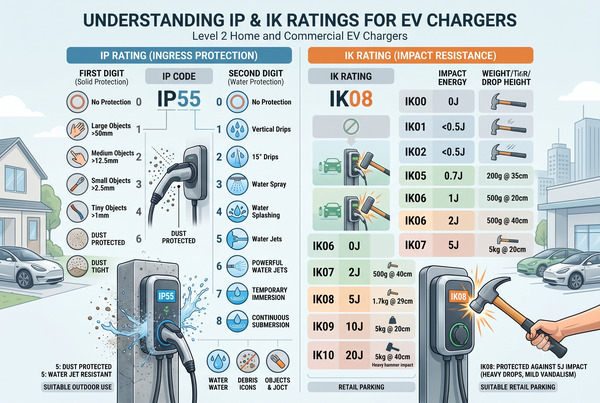
IP ratings show protection from dust and water. The first digit covers solids while the second handles liquids. IK ratings measure resistance to mechanical impacts in joules. Higher numbers mean stronger protection in each category.
At Parwatt we test our products to these standards. Let me explain the details.
IP ratings use two digits. The first ranges from 0 to 6 for dust protection. Level 6 means dust tight. The second digit from 0 to 9 covers water. IP65 resists water jets while IP67 handles temporary immersion.
IK ratings range from IK00 to IK10. Each level corresponds to impact energy. IK08 withstands 5 joules while IK10 manages 20 joules. This protects against vandalism or drops.
Common combinations for EV chargers include IP54 for indoor use and IP65 or higher for outdoors. IK07 to IK10 suit different traffic levels.
Here is a detailed comparison table:
| Rating | Protection Level | Typical Use Case |
|---|---|---|
| IP54 | Dust protected, splash water | Indoor garage |
| IP65 | Dust tight, water jets | Outdoor wall mount |
| IP67 | Dust tight, immersion | Flood prone areas |
| IK07 | 2 joules impact | Low traffic home |
| IK10 | 20 joules impact | Public stations |
Bullet points on practical meaning:
- IP first digit focuses on solid particles.
- IP second digit addresses moisture from various sources.
- IK tests use standardized hammers for consistency.
- Combined ratings give full picture of durability.
Our EP02 Portable EV Charger with Display features ratings suitable for portable outdoor use.
Testing methods ensure reliability. Manufacturers follow international standards.
Real performance depends on proper installation too. Seals must remain intact.
These explanations remove mystery from the numbers. You understand what they deliver in practice.
Our charge EV faster home vs public guide discusses equipment suited for different environments.
Knowledge of these ratings helps you evaluate products confidently.
How to Choose the Right IP and IK Rating for Your EV Charger Installation
You need guidance tailored to your situation. Here is how to decide.
Consider your installation location, climate, usage type, and potential risks. Home garage setups often need IP54 and IK07 while public outdoor stations require IP65+ and IK10.
We help customers match ratings to needs at Parwatt. Follow this approach.
Home indoor installations in garages work well with moderate ratings. Protection against dust and occasional splashes suffices.
Outdoor residential walls need stronger water resistance. IP65 handles rain and hose cleaning effectively.
Public or commercial stations face higher risks. IK10 resists impacts while high IP ratings manage weather exposure.
Climate influences choices. Coastal areas benefit from corrosion resistant designs with high IP. Cold regions need good sealing against snow and ice.
Here is a selection guide table:
| Location | Recommended IP | Recommended IK | Reason |
|---|---|---|---|
| Indoor Garage | IP54 | IK07 | Basic protection |
| Outdoor Home | IP65 | IK08 | Weather and light impact |
| Public Station | IP66/IP67 | IK10 | Heavy use and vandalism |
| Flood Area | IP67 | IK09 | Water immersion risk |
Bullet points for decision making:
- Assess daily exposure to elements.
- Consider foot traffic and possible impacts.
- Factor in cleaning methods.
- Plan for future changes in use.
Our Battery Buffered Ultra Rapid EV Charger offers robust ratings for demanding applications.
Professional advice helps. Electricians understand local conditions.
I advised clients in different climates. Matching ratings to weather extended equipment life significantly.
Cost versus benefit analysis matters. Higher ratings add value only when conditions demand them.
These strategies lead to optimal selections. Your charger performs reliably for years.
Ready to Buy the Right Protected EV Charger? Here’s Your Next Step
You understand the ratings and feel ready to choose.
Evaluate your installation location, review product specifications carefully, compare options, and consult experts if needed. These actions help you purchase the perfect protected charger.
From my position at Parwatt, I recommend starting with assessment.
Measure your space and note exposure levels. Check for rain direction, dust sources, and activity.
Review manufacturer data sheets. Look for exact IP and IK numbers plus test reports.
Compare several models. Consider features beyond ratings like smart capabilities.
Contact support teams with questions. Good manufacturers provide clear guidance.
Here is an action table:
| Step | Action | Benefit |
|---|---|---|
| Location Assessment | Note conditions | Accurate needs |
| Spec Review | Check ratings | Informed comparison |
| Option Comparison | List pros cons | Best value |
| Expert Consultation | Ask questions | Professional input |
| Purchase Decision | Buy matched unit | Long-term reliability |
Bullet points for immediate progress:
- Create a simple checklist for your site.
- Bookmark reliable product pages.
- Schedule time to compare models.
- Prepare questions for suppliers.
Our solutions page shows various protected chargers for different uses.
I have guided many purchases successfully. Customers report high satisfaction with matched protection.
Future maintenance becomes easier with right ratings. You avoid frequent replacements.
This plan turns knowledge into action. You get a charger that serves you well.
Conclusion
Understanding IP and IK ratings is essential for choosing an EV charger that will perform reliably and safely in your specific environment. While higher ratings offer better protection, the best choice balances durability, cost, and actual usage conditions. In 2026, with more chargers installed outdoors and in harsh weather, getting the right protection level prevents costly failures and ensures long-term performance. Don’t guess your charger’s protection needs. Take the time to match IP and IK ratings to your installation location for a reliable and worry-free charging experience.
FAQ
What do IP and IK ratings mean for EV chargers?
IP covers dust and water protection. IK measures resistance to physical impacts.
What is the minimum IP rating needed for outdoor EV chargers?
IP65 is a common reliable minimum for most outdoor installations.
What’s the difference between IP65 and IP67 for EV charging stations?
IP65 resists water jets. IP67 handles temporary water immersion.
Do higher IK ratings make EV chargers more expensive?
Yes, stronger impact protection usually increases manufacturing costs.
Is IP54 sufficient for a home garage EV charger?
Yes, IP54 works well for most protected indoor garage environments.
Can I install an IP-rated charger myself?
Follow manufacturer guidelines and local codes. Professional help is often safer.
Explore our full range including portable and wall mount options on the site for the right protection in your setup.

--- END ---
Related Posts


Business Ideas

Business Ideas

Business Ideas
