

EV Charger Documentation Checklist: What Importers Must Verify Before Ordering
Nov 09,2026
EV charger documentation should be treated as part of the product. It is not a collection of files to request after the purchase order has been placed or when customs, an installer or a customer asks for evidence.
A sample that charges a vehicle successfully may still lack the documentation required for importation, installation, insurance, market surveillance or after-sales service. A certificate may belong to a related model, a test report may cover another cable configuration, or the supplied manual may describe a different protection system from the product being ordered.
Connected and private-label chargers require additional control. Their technical files may need to address wireless communication, firmware, cybersecurity, data handling, OCPP, cloud services, remote updates and the identity of the business placing the product on the market.
Before ordering, importers should establish the applicable requirements for the destination country and compare every document with the exact saleable configuration. Once approved, the documentation package should be linked to the product BOM, firmware, labels, packaging, serial numbers and production test records.
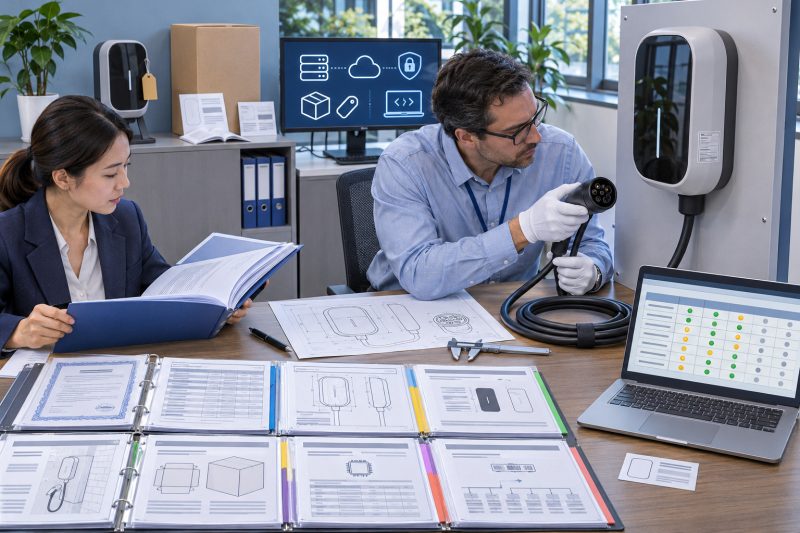
Why Incomplete Documentation Can Delay Your EV Charger Launch
EV charger projects involve more than the physical charging unit. The product must normally be supported by information that allows customs authorities, installers, distributors, project owners, inspectors and service teams to identify and handle it correctly.
Documentation gaps can delay:
- Customs clearance
- Market-access approval
- Electrical installation
- Project inspection
- Insurance acceptance
- Retail or marketplace listing
- Commercial commissioning
- Private-label launch
- Warranty handling
- Fault investigation
- Spare-parts replacement
The required package varies according to the charger type, destination market, installation environment and connectivity features. A portable residential AC charger will not necessarily require the same technical file as a public DC charger with payment, cellular communication and OCPP.
A working sample does not prove regulatory readiness
A normal charging demonstration can show that a charger communicates with one vehicle and transfers power. It does not establish that the product:
- Meets the applicable electrical-safety requirements
- Satisfies EMC requirements
- Has the required wireless approvals
- Uses an accurately declared environmental rating
- Includes compliant labels and warnings
- Has a valid market-specific conformity route
- Matches the model listed on the certificate
- Includes the correct installation instructions
- Has adequate technical documentation
- Can be traced to its production records
Importers should determine the documentation route before finalizing the product configuration. Discovering that an electrical component, connector or radio module is not covered after production has started can require retesting, relabeling or redesign.
Parwatt’s guide to EV charger safety standards and certifications explains why the applicable approval route must be identified for the exact model and installation market.
Documentation supports the entire product lifecycle
The same file package may be used by different teams for different purposes.
| Stakeholder | Documentation normally needed |
|---|---|
| Purchasing team | Specification, quotation, certification scope and approved configuration |
| Compliance team | Declaration, certificates, reports, labels and technical-file records |
| Installer | Wiring diagrams, protection requirements, mounting and commissioning instructions |
| Sales team | Accurate specifications, connector data, environmental ratings and supported functions |
| Software team | Firmware, OCPP, cloud, app, API and cybersecurity documentation |
| Warehouse | Model, serial number, carton identification and accessory list |
| Service team | Fault codes, repair procedures, spare parts and warranty terms |
| Project owner | Compliance evidence, commissioning records and maintenance requirements |
| Insurer or authority | Certification, installation, inspection, maintenance and incident records |
A document that is technically accurate but cannot be linked to the delivered product provides limited protection. Model numbers, revision codes and serial-number records must connect the file to the physical charger.
The Documentation Problems Importers Often Discover Too Late
Many importers request certificates before ordering but do not perform a detailed comparison between the paperwork and the proposed product.
Accepting a logo instead of evidence
A CE, UL, ETL or other mark shown on a brochure is not sufficient by itself. Buyers should request the supporting documentation and verify what the mark covers.
Potential problems include:
- The logo was added to a sales presentation without supporting evidence.
- The certificate applies to a component rather than the complete charger.
- The document belongs to another company.
- The approved model number differs from the quotation.
- The rating does not cover the ordered power.
- The certificate has expired or been withdrawn.
- The report covers another connector or cable.
- The listed factory is not the production site.
- The model uses a different wireless module.
- Private-label branding is not reflected in the documentation.
The buyer should independently verify searchable records through the issuing organization or official database where available.
Accepting a factory-wide certificate
A supplier may state that its factory is certified, but a management-system certificate does not establish the product compliance of every charger manufactured at the site.
Importers should distinguish among:
- Quality-management certification
- Environmental or occupational management certification
- Component approval
- Complete-product safety certification
- EMC testing
- Radio or wireless approval
- OCPP certification
- Environmental testing
- Market-specific registration
Each document answers a different question. One cannot automatically replace another.
Relying on a related-model report
Product families frequently use similar enclosures while containing different electrical configurations.
For example, one family may include:
- 3.6kW single-phase charger
- 7kW single-phase charger
- 11kW three-phase charger
- 22kW three-phase charger
- Type 1 cable version
- Type 2 cable version
- Socketed version
- Wi-Fi version
- Wi-Fi plus 4G version
- RFID version
The certificate may cover the complete family, selected variants or only one model. The importer should not assume coverage based on visual similarity or a shared commercial name.
Ignoring standard versions and report dates
The applicable requirements and referenced standards may change. Buyers should record:
- Standard number
- Standard edition or version
- Amendments
- Test date
- Certificate issue date
- Certificate status
- Transition arrangements where applicable
An older report is not automatically invalid, but its continued suitability should be confirmed for the destination market and current product configuration.
Finding label conflicts after production
Labels often remain unfinished until late in the project. This creates risk because regulatory and technical information must remain consistent across the product, packaging, manual and declaration.
Common conflicts include:
- Different model numbers
- Incorrect rated power
- Missing input voltage
- Wrong manufacturer identity
- Unsupported compliance marks
- Incorrect IP rating
- Missing serial number
- Connector information that differs from the package
- App QR code linked to the wrong platform
- Outdated importer details
Labels should be reviewed before printing and compared with the approved compliance documents.
Overlooking installation documentation
A certified charger can still be installed incorrectly if the manual does not explain:
- Supply requirements
- Earthing
- External protection
- Cable sizing
- Terminal torque
- Current configuration
- Load-management wiring
- Meter or CT orientation
- Network commissioning
- Environmental limitations
- Maintenance
- Emergency isolation
The installation manual must describe the actual production model rather than a generic product family.
How to Verify Certificates, Test Reports and Product Identity
Document verification should begin with the destination market and end with a controlled comparison against the sample and purchase specification.
Step 1: Define the destination and intended use
Record:
- Country of sale
- Indoor or outdoor installation
- Residential or commercial use
- Portable or fixed installation
- AC or DC charging
- Rated power
- Supply phase
- Connector
- Tethered cable or socket
- Smart and wireless functions
- Payment functions
- Private-label brand
- Legal manufacturer or responsible economic operator
These details determine which documents and approvals require specialist review.
Step 2: Build a document requirement matrix
| Document category | Recommended records | Main points to verify |
|---|---|---|
| Market-access documents | Declaration of Conformity, certificates, test reports and regulatory labels | Destination country, legislation, standards, exact model and responsible party |
| Product technical file | Specification, wiring diagram, installation manual, risk assessment and IP/IK evidence | Voltage, current, power, connector, protections and installation conditions |
| Software and network file | Firmware, OCPP evidence, cybersecurity policy and OTA procedure | Approved software version, offline operation, data handling, app and cloud responsibility |
| Production quality file | Approved BOM, golden sample, inspection plan and test records | Sample-to-production consistency, critical components and version control |
| After-sales file | Warranty, spare-parts list, repair instructions and escalation procedure | Warranty responsibility, parts period, remote support and claim handling |
| Traceability file | Serial-number rules, batch records and production test results | Ability to trace field failures to batch, BOM and firmware |
The matrix should identify the document owner, supplier due date, reviewer and approval status.
Step 3: Compare product identity across every file
The following information should remain consistent:
- Manufacturer name
- Factory address where relevant
- Certification holder
- Model designation
- Product family
- Input voltage
- Frequency
- Number of phases
- Rated current
- Rated power
- Connector
- Cable configuration
- Environmental rating
- Communication module
- Firmware where applicable
Create a comparison sheet rather than checking each PDF separately. Differences should be resolved in writing before order approval.
Step 4: Verify the issuing body and report
For independently certified products:
- Locate the certificate number.
- Identify the issuing organization.
- Check the official database where available.
- Confirm the certificate holder.
- Confirm the product category.
- Compare the listed models.
- Review the current status.
- Confirm the covered factory or factories.
- Check conditions or limitations.
- Save the verification evidence.
A PDF forwarded by the supplier may be genuine but incomplete, outdated or unrelated to the final model.
Step 5: Review the full report, not only the certificate
The underlying test report can reveal details not visible on the certificate, including:
- Product photographs
- Internal construction
- Critical components
- Cable and connector
- Enclosure
- PCB revision
- Protection devices
- Wireless modules
- Model differences
- Test conditions
- Deviations or conditions
Compare the photographs and component descriptions with the approved sample. If the sample differs materially, request an assessment from the supplier and, where necessary, the relevant certification or testing organization.
Step 6: Verify environmental claims
IP, IK, temperature and corrosion claims should have supporting evidence appropriate to the product and intended environment.
Confirm whether the evidence covers:
- Complete enclosure
- Cable entries
- Connector arrangement
- Display
- Payment terminal
- Ventilation openings
- Pedestal or mounting system
- Final assembly
An enclosure component’s rating does not automatically establish the rating of the finished charger.
Step 7: Verify production and factory identity
The documentation file should identify where the approved product will be made. If production moves to another factory, the importer should determine whether the relevant approvals and quality controls remain valid.
Supplier qualification should connect document review with factory capability, sample testing and pilot production. Parwatt’s guide to choosing an automotive electronics manufacturer outlines a gated process involving certificate verification, factory assessment, engineering samples, pilot production and golden-sample approval.
What Smart and Private-Label EV Chargers Require Beyond Basic Compliance
Connected chargers introduce responsibilities that continue after the hardware has been shipped. Documentation should address software, networks, data and long-term support.
Firmware documentation
The approved file should record:
- Main-control firmware
- Communication firmware
- Display software
- Power-module firmware
- Load-controller firmware
- Release date
- Change history
- Known limitations
- Update procedure
- Rollback method
A firmware update can affect charging, protection, metering, OCPP or cybersecurity. It should therefore be subject to controlled release and regression testing.
OCPP documentation
A statement that a charger “supports OCPP” is not enough. Importers should request:
- OCPP version
- Supported profiles
- Certification status
- Certified product designation
- Certified firmware or software version
- CSMS compatibility record
- Configuration instructions
- Backend migration procedure
- Network-loss behavior
- Test results with the intended platform
If official certification is claimed, compare the charger designation and software version with the relevant official record.
OCPP also affects future platform flexibility. Parwatt’s discussion of future-proof EV charging equipment explains how open protocols, remote diagnostics, OTA capability and spare-parts support contribute to the long-term serviceability of charging assets.
Cybersecurity file
Depending on the market and product, the documentation may need to address:
- Unique credentials
- Password policy
- Secure boot
- Signed firmware
- Encrypted communication
- Access control
- Vulnerability reporting
- Software-support period
- Security-update policy
- Data retention
- Incident response
- End-of-support process
The importer should understand who receives vulnerability reports and how urgent updates will reach installed products.
Cloud and app responsibility
The software file should identify:
- App developer
- Platform operator
- Server operator
- Server location
- Data controller and processor roles
- Service fees
- Support contact
- Availability commitment
- Backup arrangements
- Data-export options
- Service termination process
If the supplier stops operating the cloud service, buyers should know whether the charger can continue locally or migrate to another platform.
Software can materially affect charger availability and after-sales costs. Parwatt’s article on software for improving EV charger uptime discusses remote monitoring, fault reporting, remote control and maintenance data as part of the operating system rather than optional marketing features.
Offline-operation documentation
The file should describe what happens when Wi-Fi, Ethernet, cellular service or the cloud platform becomes unavailable.
Confirm whether the charger can:
- Start locally
- Validate RFID cards locally
- Continue an active session
- Retain schedules
- Store transactions
- Preserve meter values
- Recover automatically
- Synchronize after reconnection
- Receive emergency commands
- Operate at a safe fallback power
Offline behavior should be documented and physically tested.
Private-label responsibility
Selling a charger under the importer’s own name may affect regulatory responsibilities, depending on the market and the extent of the modification.
The private-label file should clarify:
- Brand owner
- Legal manufacturer
- Importer
- Authorized representative where applicable
- Certification holder
- Declaration signatory
- Technical-file owner
- Label identity
- Warranty provider
- App and cloud provider
- Product-traceability contact
The private-label name should appear consistently where required across:
- Product label
- Packaging
- Manual
- Declaration
- Warranty
- App
- Website
- Traceability records
Changing only the logo on the enclosure without reviewing the declaration, manual and technical file can create conflicting responsibility information.
How to Build a Pre-Order Documentation Approval File
The pre-order file should become the controlled source used by purchasing, engineering, compliance, production and after-sales teams.
Create a master document index
The index should contain:
- Document name
- Document number
- Product model
- Revision
- Issue date
- Supplier
- Reviewer
- Approval status
- Expiry or review date
- Storage location
- Notes or limitations
Avoid relying on an email folder filled with unclassified PDFs. A structured index makes gaps and inconsistencies visible.
Divide the file into controlled sections
A practical approval file may contain:
- Commercial and product identity
- Market-access documents
- Test reports
- Product specification
- Critical BOM
- Firmware and software
- Labels and packaging
- Installation and user manuals
- Sample-test results
- Golden-sample record
- Production inspection plan
- Traceability procedure
- Warranty and service
- Change-control agreement
Freeze the approved configuration
The final approval sheet should list:
- Exact model
- Electrical rating
- Connector
- Cable
- Meter
- PCBA revision
- Communication module
- Firmware
- OCPP version
- Enclosure
- Label
- Packaging
- Accessories
- Manual
The purchase order should refer to this controlled specification rather than a general catalogue page.
Link documentation to the golden sample
The golden sample should represent the complete product described by the approved documents.
Retain:
- Sample photographs
- Sample serial number
- Label photograph
- Connector and cable markings
- Internal revision identification where appropriate
- Firmware screenshots
- App version
- Packaging
- Accessories
- Test record
- Approval signatures
If the golden sample and certification file describe different configurations, production should not begin until the difference is resolved.
Freeze critical BOM information
The controlled BOM should identify safety-, performance- and compliance-critical components.
Examples include:
- Power semiconductors
- Contactors
- Relays
- Current sensors
- Residual-current monitoring devices
- Temperature sensors
- Energy meter
- Communication modules
- Connector
- Cable
- Terminals
- Gaskets
- Enclosure material
- Cooling components
- DC power modules
Changes to critical components should trigger a documented review of testing and certification impact.
Establish document change control
The supplier should obtain written approval before changing:
- Product model
- Electrical rating
- PCB or PCBA
- Critical component
- Connector
- Cable
- Meter
- Communication module
- Firmware
- App
- Cloud platform
- OCPP implementation
- Label
- Manual
- Packaging
- Factory location
The change request should state:
- Reason for change
- Old and new configuration
- Technical impact
- Compliance impact
- Software impact
- Stock affected
- Proposed validation
- Implementation date
No change should enter mass production merely because the replacement component appears equivalent.
Connect documents to serial-number traceability
Each charger’s serial number should allow the buyer and supplier to identify:
- Production date
- Production batch
- Factory
- BOM revision
- Firmware version
- Final-test result
- Repair history
- Packaging version
Traceability becomes essential when a field issue affects only one component lot or firmware release.
Define production and inspection records
The documentation package should specify what the factory checks during:
- Incoming inspection
- Assembly
- In-process quality control
- End-of-line testing
- Final inspection
- Packaging
- Pre-shipment inspection
Request the EOL test specification and sample production records. The buyer should know whether results are stored individually or only summarized by batch.
Prepare the after-sales package
Before the order is placed, agree on:
- Warranty period
- Warranty start date
- Exclusions
- Claim evidence
- Remote-diagnosis procedure
- Fault-code list
- Spare-parts list
- Parts-supply period
- Repair authorization
- Replacement process
- Response time
- Escalation contacts
- Software-support responsibilities
The after-sales file should also define how data and logs will be preserved during an incident. Parwatt’s guide to EV charging station insurance and liability highlights the importance of retaining certification, installation, maintenance and incident records throughout operation.
Use an approval gate before issuing the purchase order
The order should not be released until the following items are complete:
- Destination-market requirements identified
- Exact charger configuration frozen
- Certificates independently verified
- Test reports reviewed
- Product and report photographs compared
- Declaration checked
- Label approved
- Installation manual approved
- Firmware and OCPP version recorded
- App and cloud responsibilities agreed
- Private-label responsibilities clarified
- Critical BOM controlled
- Golden sample approved
- Production test plan reviewed
- Serial-number traceability confirmed
- Warranty and spare-parts plan approved
- Change-control agreement signed
Conclusion
EV charger documentation should be treated as part of the product—not as paperwork to collect after the purchase order has been placed. The required document package will vary by destination market, charger type, installation environment and connectivity features.
Importers should verify the exact model, electrical configuration, connector, legal manufacturer, certification holder, applicable standards and software version before approving an order. For smart or private-label chargers, the review should also cover cybersecurity, data handling, firmware updates, cloud services and branding responsibilities.
Once approved, the documentation package should be linked to the production BOM, labels, manuals, firmware and serial-number records. This approach helps reduce compliance delays, prevent sample-to-production inconsistencies and create a clearer basis for installation, sales and after-sales support.
FAQ
1. What documents should importers request from an EV charger supplier?
Importers should request the applicable declaration, certificates, test reports, technical specification, installation manual, user instructions, wiring diagrams, label files, critical BOM, firmware information, production test plan, traceability procedure, warranty and spare-parts documentation. Smart chargers also require software, OCPP, cybersecurity, cloud and data-handling records.
2. Is a CE certificate enough to import an EV charger into Europe?
A generic CE certificate or logo is not sufficient by itself. Buyers should review the applicable EU Declaration of Conformity and supporting technical documentation. The legal manufacturer, exact model, ratings, relevant legislation and standards should match the product being placed on the market.
3. How can buyers verify an EV charger’s UL or ETL certification?
Buyers should obtain the certificate or listing number and search the official certification organization’s database. They should compare the listed company, model, product category, ratings, factory and current status with the charger being ordered. A component recognition should not be mistaken for complete end-product certification.
4. What documentation is required for a smart or OCPP-enabled EV charger?
In addition to electrical and compliance documents, buyers should request firmware records, OCPP version and certification evidence, backend compatibility, cybersecurity policy, OTA procedure, offline behavior, app ownership, cloud-service responsibilities, data handling and software-support commitments.
5. Does private labeling change an importer’s compliance responsibilities?
It can. The effect depends on the destination market and the changes made to the product. Selling under the importer’s name or modifying the product may create manufacturer-level responsibilities. The label, declaration, technical file, manuals, warranty and traceability records should identify the responsible parties consistently.
6. How can buyers ensure bulk production matches the approved documentation?
They should freeze the configuration, critical BOM, firmware, labels and packaging; retain a golden sample; establish written change control; and link serial numbers to production and final-test records. Pre-production and pre-shipment inspections should compare mass-produced units with the approved documents and sample.

--- END ---
Related Posts
Business Ideas

Level 1 vs Level 2 EV Charging: What Buyers Should Check Before Ordering
November 20, 2026
Business Ideas

Company News

Industry News


