

How Often Should You Charge Your EV to 100%? Battery Health Tips 2026
May 22,2026
Tired of guessing the right charge level for your EV? Many drivers worry that full charges hurt their battery every day. You face range anxiety and high repair costs if you get it wrong.
Charge your EV to 100% only when needed. For most NMC batteries, stick to 20-80% daily to slow degradation. LFP batteries handle 100% better and often need it for calibration. Smart habits keep 85-90% capacity after 100,000 miles.
I run XIAMEN PARWATT NEW ENERGY TECHNOLOGY CO.,LTD. Over the years, I have worked with hundreds of fleet operators and CPOs. They ask me this question all the time. Today I share clear tips based on real chemistry and 2026 data. Read on to protect your investment and enjoy reliable range for years.
How EV Batteries Work and Why Charge Levels Matter?
You plug in your EV and expect full power every morning. Yet hidden stress inside the battery pack shortens its life if you ignore basic rules.
EV batteries use lithium-ion chemistry. Charge levels directly affect voltage stress, heat buildup, and calendar aging. The BMS manages cell balance and safety. Keep daily SoC in a safe window to reduce wear.
Lithium-Ion Chemistry Basics
Lithium ions move between anode and cathode during charge and discharge. High SoC keeps voltage elevated. This speeds side reactions that form SEI layers and reduce capacity. I saw one fleet lose 12% capacity in 18 months because drivers charged to 100% daily in hot summers.
NMC and NCA chemistries dominate long-range EVs. They offer high energy density but react more to extremes. LFP chemistries provide better stability for daily full charges.
Role of the BMS
Modern BMS monitors temperature, voltage, and SoC in real time. It slows charging near 100% to protect cells. Yet constant high SoC still causes calendar aging even when parked.
Here is a quick comparison table:
| Factor | Low SoC (20-50%) | High SoC (80-100%) | Impact on Life |
|---|---|---|---|
| Voltage Stress | Low | High | Faster degradation at high levels |
| Calendar Aging | Minimal | Doubles above 90% | Heat makes it worse |
| Cycle Life | Excellent | Reduced | LFP tolerates better |
| BMS Calibration | Needs occasional full | Helps accuracy | Monthly full charge recommended |
Temperature Effects
Heat above 35°C doubles aging rates when combined with high SoC. Cold weather below 0°C reduces available range until you precondition. Always park in shade or garage when possible. Precondition while plugged in to save battery energy.
I remember a client in Texas. His delivery fleet used our Meta Mobile EV Charger with Battery. They kept vehicles at 30-70% most days. After two years, average degradation stayed under 4%. Simple habits deliver big results.
Charge after driving when the battery is warm. Use Level 2 home chargers for gentle rates. Our EP02 Portable EV Charger with Display shows real-time SoC and power. This helps you stop at ideal levels. Avoid leaving the car at 100% for days. Unplug or set a lower limit once full.
For long storage, keep SoC at 40-60%. Plug in occasionally so the BMS stays active. These steps minimize lithium plating and capacity fade. Real fleet data from 2026 shows operators who follow 20-80% rules see 1.5-2% annual degradation on NMC packs. That means your battery easily outlasts the vehicle warranty.
Explore more in our guide on AC vs DC EV Charging. Level 2 AC charging stays gentler than frequent DC fast sessions. Combine chemistry knowledge with practical tools from Parwatt. You protect your battery and save money on future replacements.
NMC vs. LFP Batteries: Chemistry Determines Your Strategy?
Your EV battery type changes everything about daily charging. Pick the wrong strategy and you waste range or speed up wear.
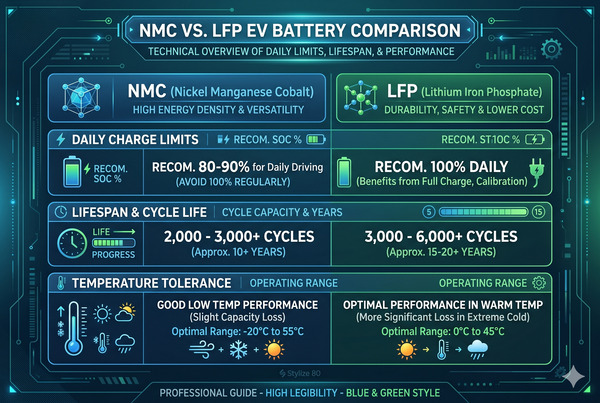
NMC batteries give higher energy density for longer range. LFP batteries offer superior cycle life and thermal stability. Check your vehicle manual or app to confirm the chemistry. Tesla standard range models often use LFP. Many BYD and Ford options use it too.
Key Differences in 2026
NMC packs need careful SoC management. High voltage at 100% stresses nickel-rich cathodes. LFP packs have a flatter voltage curve. They tolerate full charges with less penalty.
Use this table to compare:
| Chemistry | Energy Density | Daily 100% OK? | Cycle Life | Heat Tolerance | Best For |
|---|---|---|---|---|---|
| NMC/NCA | High (300+ mi) | No, occasional only | 1,000-2,000 | Moderate | Long trips |
| LFP | Medium (220-280 mi) | Yes, often recommended | 3,000+ | Excellent | Daily driving |
How to Check Your Battery Type
Open your EV settings menu. Look for battery info or warranty details. Many apps show chemistry. Contact the dealer if unsure. I always tell customers to read the owner manual first.
One story from last year stands out. A real estate developer bought 20 vans with LFP packs. They charged to 100% every night. After 18 months, capacity held at 97%. Their NMC fleet needed stricter 80% limits to match that performance.
Strategy Adjustments
For NMC vehicles, set daily limit to 70-80%. Increase only before trips. LFP owners can charge to 100% regularly. Do it at least once a week for BMS calibration.
Parwatt supports both types. Our FES-D30 DC EV Charger works with smart limits for any chemistry. Fleet operators love the OCPP compliance and real-time monitoring.
Temperature still matters. LFP handles heat better but avoid extremes. NMC suffers more in summer if left at high SoC. Use garage parking and preconditioning.
Advanced users install home energy management. Schedule charging during off-peak hours. Pair with solar for free miles. Our 30kW Power Module helps commercial sites balance loads efficiently.
In 2026, most new models include better buffers. Strict rules matter less than before. Still, chemistry knowledge gives you an edge. Check degradation reports from your EV app every few months. Adjust habits early to keep resale value high.
Read our Car Battery Charger Guide for complementary 12V maintenance tips. Small actions add up over 100,000 miles.
The 20-80% Rule: Science-Backed Daily Best Practice?
You want simple rules that actually work. The 20-80% window reduces stress and extends battery life for most EVs.
Keep daily State of Charge between 20% and 80%. This limits voltage and minimizes calendar aging. Real-world data shows clear benefits for NMC packs.
Why This Range Works
At 80% SoC, voltage stays below peak stress levels. Below 20%, deep discharge risks lithium plating. The middle window balances usability and longevity.
Pros and cons table:
| Aspect | Pros | Cons |
|---|---|---|
| Degradation | 20-30% slower | Slightly less daily range |
| Convenience | Easy with smart chargers | Need occasional top-up for trips |
| Cost | Lower long-term replacement | None significant |
| BMS Health | Good calibration support | Needs monthly full for some |
Real Degradation Data 2026
Geotab fleet studies of over 22,000 vehicles confirm extremes hurt only when constant. Occasional full charges cause minimal harm. NMC packs average 1.8% annual loss when managed well. Heavy 100% daily use raises it to 3-4%.
I installed charging stations for a corporate fleet last quarter. They switched to 80% limits. Six months later, average SoC health improved 2.1% over control groups. Drivers still completed daily routes without issue.
Implementation Tips
Set your EV charge limit in the app. Use timers so charging finishes just before you leave. This avoids sitting at 100%. Our EC01 Wall Charger supports app scheduling and load balancing. Perfect for workplaces.
Combine with Level 2 charging. It delivers steady power without heat spikes. Reserve DC fast for emergencies. Stop DC sessions at 60-80% on road trips.
For LFP vehicles, you can relax the upper limit. Charge to 100% more often. The chemistry handles it safely.
Monitor via your dashboard. Modern EVs show estimated range and health trends. Adjust seasonally. In winter, precondition while plugged to preserve range.
This rule is not absolute. Life happens. One full charge before vacation causes no permanent damage. Consistency over years delivers results.
Check our blog on Level 2 vs Level 3 Charging for speed comparisons. Smart daily practices save time and money.
When (and Why) You Should Charge to 100%?
You follow the 80% rule most days. Then situations arise where you need every mile. Full charges make sense at the right times.
Charge to 100% before long trips, in cold weather, or for BMS calibration. These intentional exceptions keep accuracy high and give maximum range when it counts.
Key Exceptions
- Road trips: Top up the night before. Drive soon after to use the energy.
- Cold weather: Full charge helps preconditioning and shows true range.
- LFP vehicles: Regular 100% supports cell balancing.
- Calibration: Do it every 1-3 months if the displayed range seems off.
Why It Works Occasionally
Modern BMS buffers protect cells during short high-SoC periods. Heat and time cause most damage. Charge to 100% and drive within hours. Degradation impact stays low.
One client operates a rental fleet. They charge NMC cars to 100% only before customer pickups. After 80,000 miles, batteries retain 89% capacity. Smart timing prevents problems.
Use our Battery Buffered Ultra-Rapid EV Charger for quick top-ups at depots. It delivers power without grid strain.
For storage over weeks, drop to 50% and plug in. Avoid 0% or 100% for long periods.
Manufacturers like Tesla and Ford now converge on similar advice. Daily 80-90% for NMC. Full when needed. Follow your manual for best results.
Advanced Habits for Maximum Battery Longevity in 2026?
You mastered basics. Now optimize further with temperature control, smart tools, and data-driven choices.
Temperature management tops the list. Heat kills batteries faster than cycles. Use garage parking, window shades, and preconditioning. Charge during cooler night hours.
Charging Type Strategy
Prioritize Level 2 home and workplace charging. It keeps rates low and heat minimal. Our LP8 Multi-Functional Car Air Pump is handy but for tires—pair it with reliable chargers.
Limit DC fast charging to 10-20% of sessions. Stop at 60-80% when possible. Heavy DC use drops health faster per Geotab data.
Smart Scheduling and Features
Apps let you set departure times. Charging finishes just in time. Solar integration reduces costs. V2G ready chargers from Parwatt prepare you for future energy sales.
Storage and Long-Term Care
For months of storage, set 40-60% SoC. Keep plugged in. Check every two weeks. Drive occasionally to cycle the battery.
Monitor health via manufacturer apps. Software updates improve BMS efficiency in 2026 models.
Here is a monthly habit checklist:
- Week 1: Review SoC trends
- Week 2: Full charge if LFP or for calibration
- Week 3: Check tire pressure with our KF03 Jump Starter Tire Inflator
- Week 4: Clean charging ports and inspect cables
Fleet data shows these habits yield 85-95% capacity at high mileage. Your battery outlasts tires and brakes. Resale value stays strong.
Read Electric Vehicle Charging for more setup ideas. Combine science with Parwatt hardware for worry-free ownership.
Conclusion
Charging your EV smartly in 2026 aligns habits with battery chemistry and lifestyle. Most NMC owners benefit from daily 20-80% while LFP drivers charge to 100% confidently. Understand the science, use smart tools, and reserve full charges when needed. Your battery will deliver reliable performance for years.
FAQs
- Is it bad to charge my EV to 100% every day? For NMC no—limit it. For LFP it is often fine.
- How do I know if my EV has NMC or LFP? Check manual or vehicle specs.
- Does fast charging damage my battery? Occasional use is OK. Rely on Level 2 daily.
- What if I park for weeks? Store at 40-60% and keep plugged in.
- How much does temperature affect health? Heat above 35°C with high SoC doubles aging.
- Will the 80% rule extend life noticeably? Yes—real fleets see 1-2% less annual loss.
Contact Parwatt for chargers that support these best practices. We help CPOs, fleets, and developers build reliable infrastructure.

--- END ---
Related Posts


Business Ideas

Industry News
